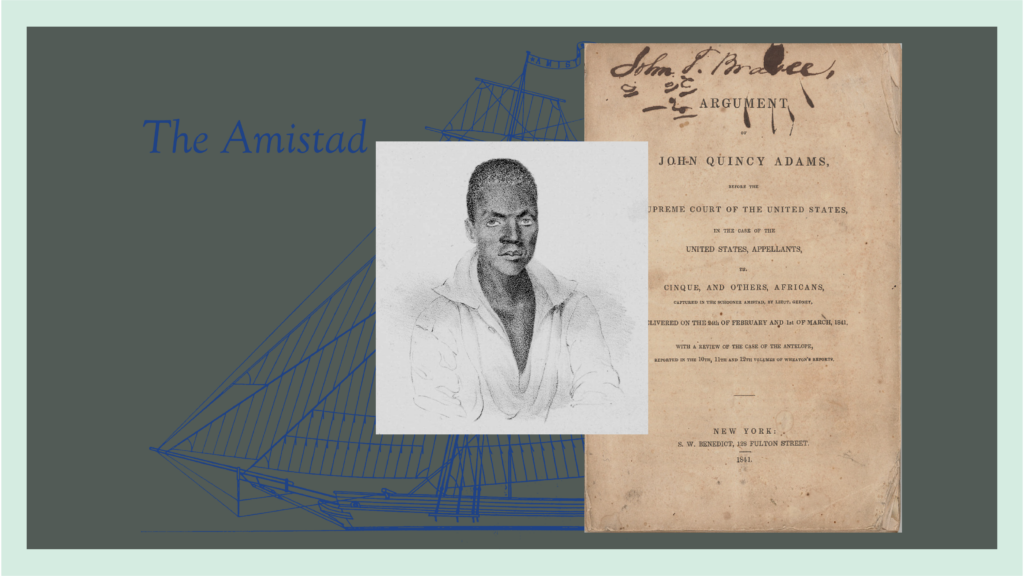
A pivotal yet often overlooked moment in U.S. history is the case of the United States v. The Amistad. Although a landmark case involving questions of slavery, international law, and human rights, the Amistad rebellion is frequently underrepresented in standard history curriculum. Why is the Amistad not as widely taught as other landmark cases? How do race, power, and national identity shape which histories are emphasized or ignored?
Reading
“Tappan understood the importance of public opinion and made sure that sympathetic newspapers frequently reported on the condition of the captives and the efforts to instruct them. Racist newspapers devoted just as much attention to the case, with frequent articles mocking the abolitionists and describing the Africans as uncivilized brutes. When the marshal transported most of the captives to Hartford for the sessions of the two federal courts in mid-September, the city was ‘crowded with strangers, and alive with excitement.’ ‘Abolitionists are here, and anti-Abolitionists are here also’ to see how the federal courts would deal with the Africans alleged to be both criminals and property.” (Ragsdale)
Ragsdale, Bruce A. “Incited By the Love of Liberty”: The Amistad Captives and the Federal Courts.” Prologue Quarterly of the National Archives 35, no. 1 (2003): 12–24.
More Reading on the Topic
Rediker, Marcus. The Amistad Rebellion: An Atlantic odyssey of slavery and freedom. Penguin, 2013.
From the publisher: “In this powerful and highly original account, Marcus Rediker reclaims the Amistad rebellion for its true proponents: the enslaved Africans who risked death to stake a claim for freedom. Using newly discovered evidence and featuring vividly drawn portraits of the rebels, their captors, and their abolitionist allies, Rediker reframes the story to show how a small group of courageous men fought and won an epic battle against Spanish and American slaveholders and their governments. The successful Amistad rebellion changed the very nature of the struggle against slavery. As a handful of self-emancipated Africans steered their own course for freedom, they opened a way for millions to follow.”
Stanley, Amy Dru. From bondage to contract: Wage labor, marriage, and the market in the age of slave emancipation. Cambridge University Press, 1998.
From the Cambridge University Press: “In the era of slave emancipation no ideal of freedom had greater power than that of contract. The antislavery claim was that the negation of chattel status lay in the contracts of wage labor and marriage. Signifying self-ownership, volition, and reciprocal exchange among formally equal individuals, contract became the dominant metaphor for social relations and the very symbol of freedom. This 1999 book explores how a generation of American thinkers and reformers – abolitionists, former slaves, feminists, labor advocates, jurists, moralists, and social scientists – drew on contract to condemn the evils of chattel slavery as well as to measure the virtues of free society. Their arguments over the meaning of slavery and freedom were grounded in changing circumstances of labor and home life on both sides of the Mason-Dixon line. At the heart of these arguments lay the problem of defining which realms of self and social existence could be rendered market commodities and which could not.”
Podcast
“In this week’s episode, AFROFILES’ Leslie Rose talks with Dr. Marcus Rediker about the history of the Amistad Rebellion, a mutiny staged by enslaved Africans aboard the Spanish ship La Amistad in 1839. The vessel was ultimately taken into custody by the US Navy, and the 53 enslaved people were charged with piracy and murder. Their trial in New Haven, Connecticut became a lightning rod for US abolitionists, and the eventual repatriation of the defendants to Sierra Leone stands as a rare triumph in the story of resistance to the slave trade.” (Afrofiles)
Podcast: Afrofiles
Date: June 13, 2021
Duration: 30 minutes
In-Class Discussion
Curious if your students were taught the Amistad Case in high school? Have them take a poll! The polling results can be done live or shared afterwards for discussion.
Individual or Group Activity
(Depending on your style and class type, this can be adapted to before class/during class or online.)
- Introduce your students to an online newspaper archive available to them, and that has coverage of the Amistad case.
- Have students find a few articles and organize them so there is limited or no overlap (i.e. insert the citation on a shared document or post on a discussion board).
Research Prompts
(See the below Mural board as a way for students to work collaboratively or to show their work.)
- How far before the court’s decision was this published?
- What was the opinion of the writer? (Pro Freedom or Pro Slavery)
- How do you know this?
Discussion Prompts
- What was it like finding your article?
- What was it like reading an article from nearly 200 years ago?
- How does word choice indicate opinion?
- How do you think word choice affects public opinion?
Additional Teaching Resource
“Students will analyze specified passages from the Supreme Court’s decision in United States v. Libellants of Schooner Amistad to explore the concept of jurisdiction and how a case travels through the Federal court system. Students will also interpret the Supreme Court’s role in the judicial branch by connecting the document back to the United States Constitution, and ultimately decide if they agree with the Supreme Court’s ruling in the case.” (Docs Teach)
Tips for Student Engagement
Encourage students to reflect on their learning process as well as the material.
Before beginning a large group discussion, have students share something about their research process in pairs or small groups before sharing out.
If you want to go deeper on a few articles, set the expectation before students begin the assignment. Offer a participation point if their are willing to have their work used as an example.