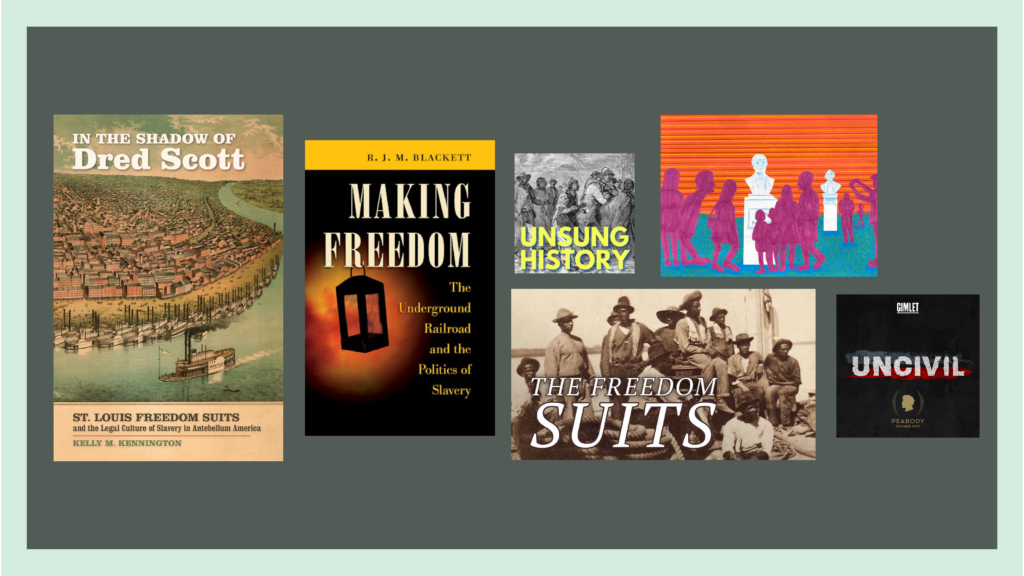
In this module, Comparing Methods of Making Freedom, students compare two distinct approaches—the legal challenge embodied in the Dred Scott decision and the direct action of the Underground Railroad. Students will examine how freedom has been fought for in different ways.
Dred Scott sought freedom through the court system, whereas the Underground Railroad was a decentralized resistance of collective and secretive action helping enslaved people escape in direct challenge to the law.
Readings
“The Dred Scott suit for freedom, argues Kelly M. Kennington, was merely the most famous example of a phenomenon that was more widespread in antebellum American jurisprudence than is generally recognized. The author draws on the case files of more than three hundred enslaved individuals who, like Dred Scott and his family, sued for freedom in the local legal arena of St. Louis. Her findings open new perspectives on the legal culture of slavery and the negotiated processes involved in freedom suits.” (University of Georgia Press)
Kennington, Kelly M. In the Shadow of Dred Scott: St. Louis Freedom Suits and the Legal Culture of Slavery in Antebellum America. Vol. 4. University of Georgia Press, 2017.
“The 1850 Fugitive Slave Law, which mandated action to aid in the recovery of runaway slaves and denied fugitives legal rights if they were apprehended, quickly became a focal point in the debate over the future of slavery and the nature of the union. In Making Freedom, R. J. M. Blackett uses the experiences of escaped slaves and those who aided them to explore the inner workings of the Underground Railroad and the enforcement of the Fugitive Slave Law, while shedding light on the political effects of slave escape in southern states, border states, and the North.” (UNC Press)
Blackett, Richard JM. Making Freedom: The Underground Railroad and the Politics of Slavery. UNC Press Books, 2013.
Additional Reading on the Topic
Jones, Martha. Birthright Citizens: A history of Race and Rights in Antebellum America. Cambridge University Press, 2018.
“Before the Civil War, colonization schemes and black laws threatened to deport former slaves born in the United States. Birthright Citizens recovers the story of how African American activists remade national belonging through battles in legislatures, conventions, and courthouses. They faced formidable opposition, most notoriously from the US Supreme Court decision in Dred Scott.” (Cambridge University Press
Podcasts
“From the late 18th Century until the Civil War, enslaved families in Prince George’s County, Maryland, brought over a thousand legal suits against hundreds of slaveholding families, arguing for their freedom. In these freedom suits, enslaved individuals sued for their freedom based on issues of breach of contract or unjust detainment. When an enslaved person won a freedom suit the individual would be granted their freedom, and it could sometimes provide the basis for future lawsuits by family members, but the institution of slavery persisted.” (Unsung History)
Episode: Freedom Suits in Maryland and DC, 1790–1864
Podcast: Unsung History
Date: September 27, 2021
Duration: 45 minutes
“Dred Scott v. Sandford is one of the most infamous cases in Supreme Court history: in 1857, an enslaved person named Dred Scott filed a suit for his freedom and lost. In his decision, Chief Justice Roger Brooke Taney wrote that Black men “had no rights which the white man was bound to respect.” One Civil War and more than a century later, the Taneys and the Scotts reunite at a Hilton in Missouri to figure out what reconciliation looks like in the 21st century.” (WNYC Studios, More Perfect)
Episode: Not Even Past: Dred Scott Reprise
Date: July 20, 2023
Duration: 40 minutes
“A young woman, held by one of America’s founding slaveowners, bolts one day for a life of freedom that keeps her on the lam for the rest of her life, eventually touching upon the life of the most notorious slaveowner of the Civil War.” (Uncivil)
Episode: The Fugitive
Date: November 9, 2018
Duration: 30 minutes
“About 400 slaves filed suits demanding freedom in Missouri Courts in the 57 years between the Louisiana Purchase and the Emancipation Proclamation. Artist Preston Jackson’s design memorializes those courageous slaves and lawyers, who went to court in St. Louis to sue for their freedom.” (The Freedom Suits Memorial)
Video: The Freedom Suits Documentary
Date: November 9, 2018
Duration: 30 minutes
In-Class Discussion
Compare and contrast Kennington’s discussion on Freedom Suits and Blackett’s discussion on the Underground Railroad. Using an online collaborative tool like Mural, or on a white board, have students list out as many similarities and differences as they can generate. As you generate ideas, prompt students to think about what evidence they have, and why the method either overlap or contrast.
Student Prompts
- What is the method of escape? What is the process? Thank about time, duration, place, and situations.
- What is the role of power? How is power enacted?
- What types of materials or evidence are left for us to study?
- How is race being defined or created in the quest for freedom?
Tips for Student Engagement
As a group, create ground rules for participation such as “allow everyone a chance to speak,” or “criticize ideas, not individuals.”
Encourage thinking out the box and making an exhaustive list.
Prompt students to respond directly to each other and build off of each other’s ideas.