This module centers on Johnnie Tillmon, welfare rights, Black women’s political organizing, gender, economic inequality, representation, and the ways institutions and public narratives shape who is understood as deserving of social support. The prompts repeatedly ask students to examine identity, stereotypes, morality, individual merit, political rhetoric, imagery, and systems of power.
Gallery

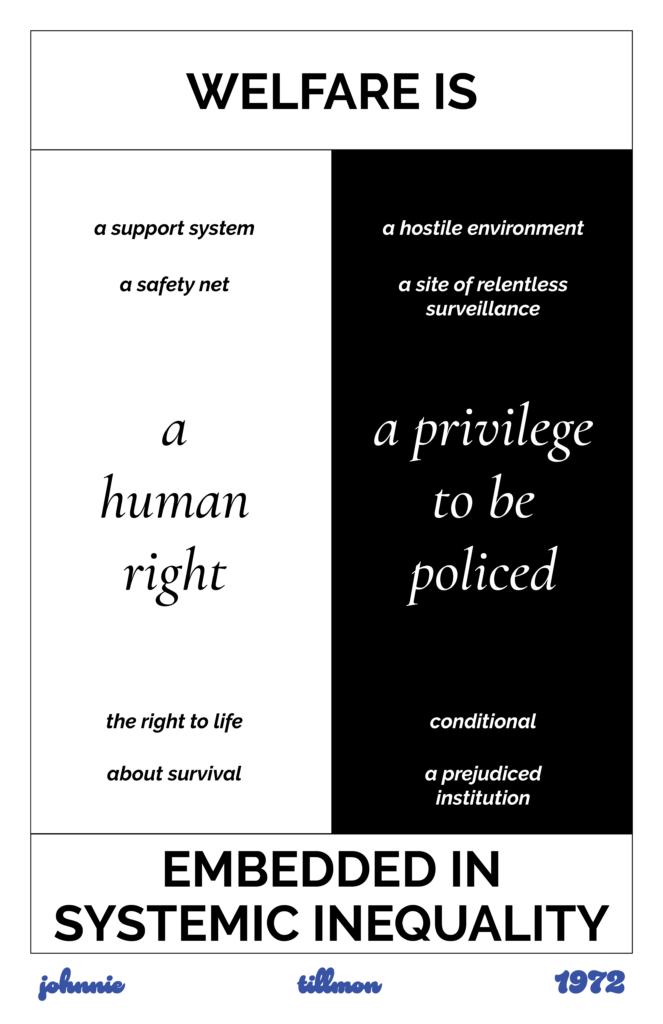


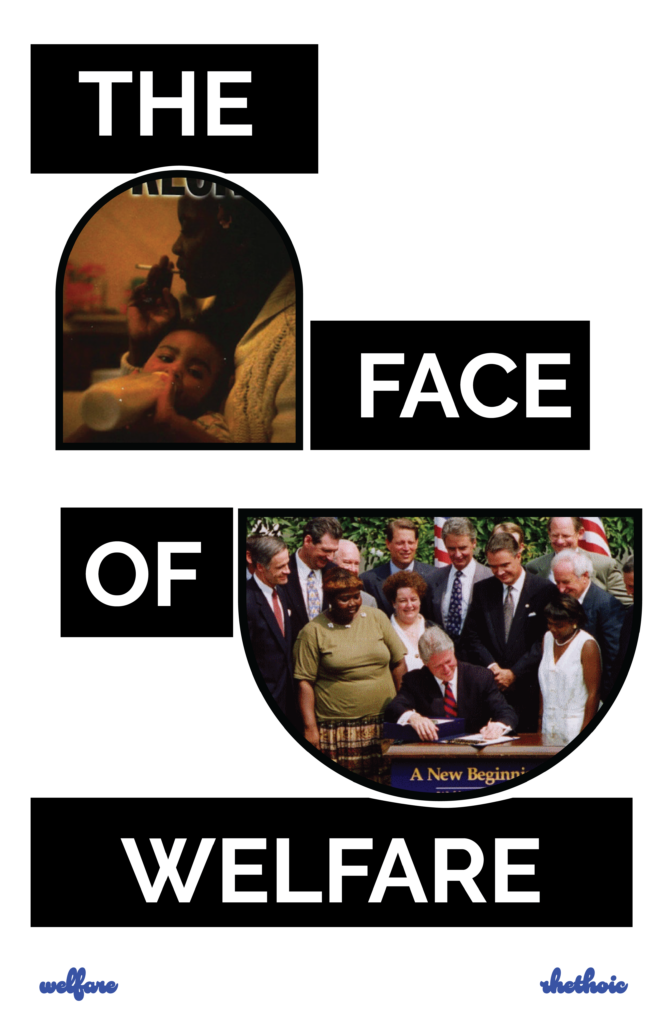
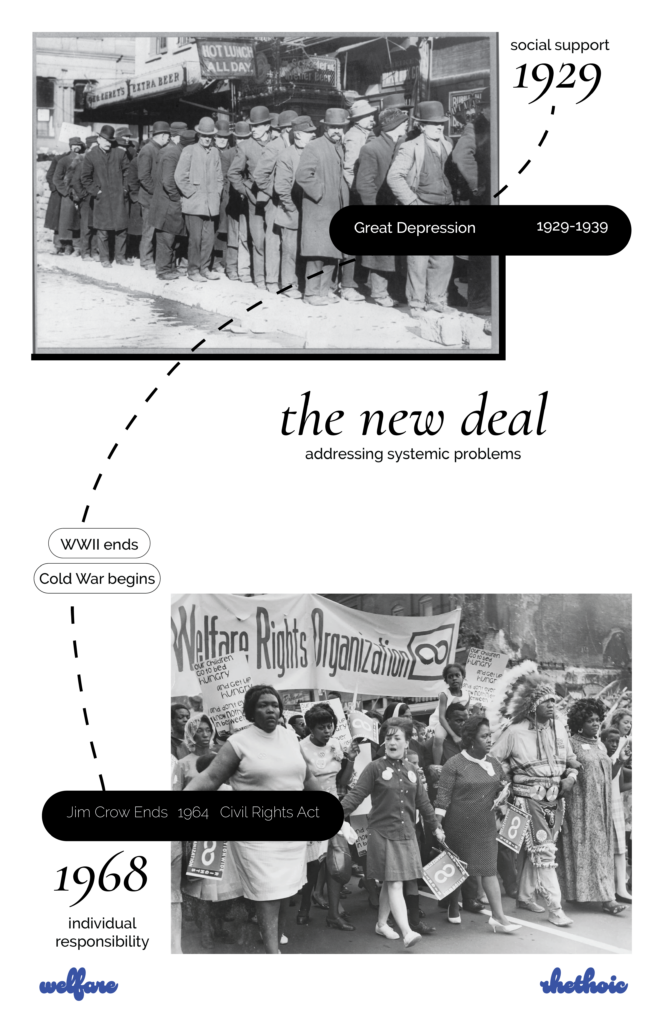
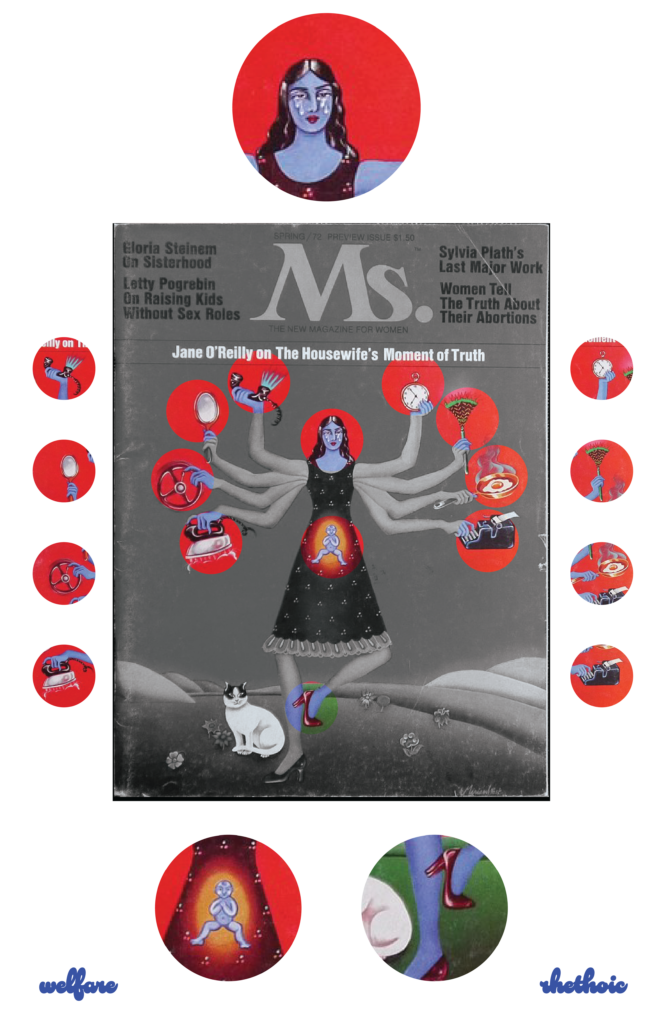
Poster 1 Prompts
Johnnie Tillmon “Welfare Is A Women’s Issue”
- Why do you think Tillmon begins her essay by stating her various identities?
- Why is she using this type of repetition?
Poster 2 Prompts
Johnnie Tillmon “Welfare Is A Women’s Issue”
- How can the same service be described and experienced so differently?
- What would you add to this black/white view? Is there a gray zone?
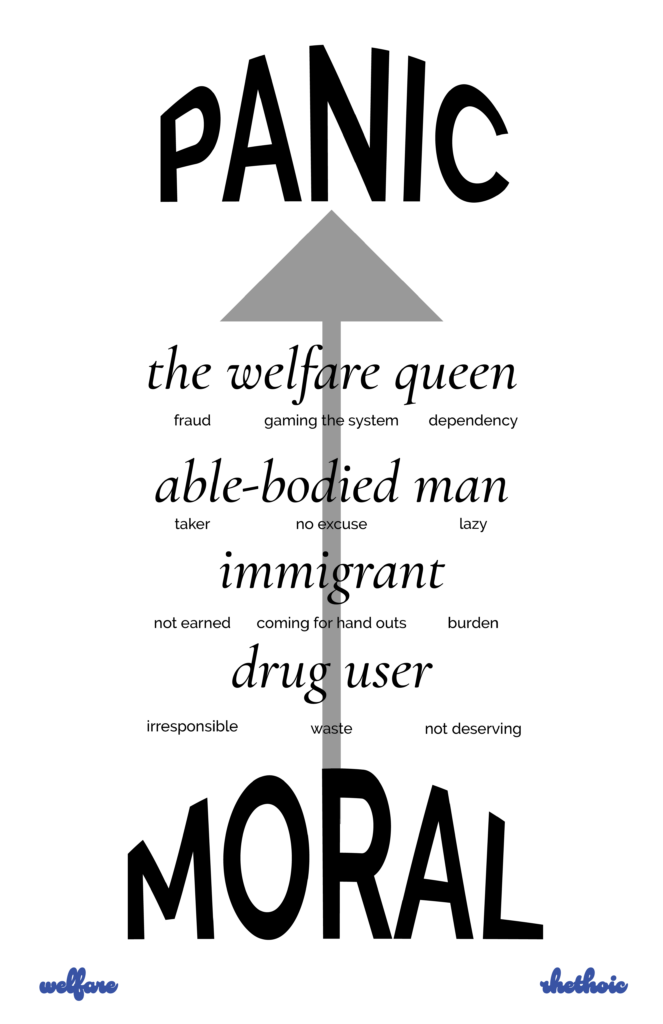
Poster 3 Prompts
Johnnie Tillmon “Welfare Is A Women’s Issue”
- What is the difference between a man and the man? What is Tillmon saying?
- What are the larger systems at play?
Poster 4 Prompts
Johnnie Tillmon “Welfare Is A Women’s Issue”
- How does morality impact public opinion on who “should” receive social care?
- How do morals build off of and strengthen stereotypes?
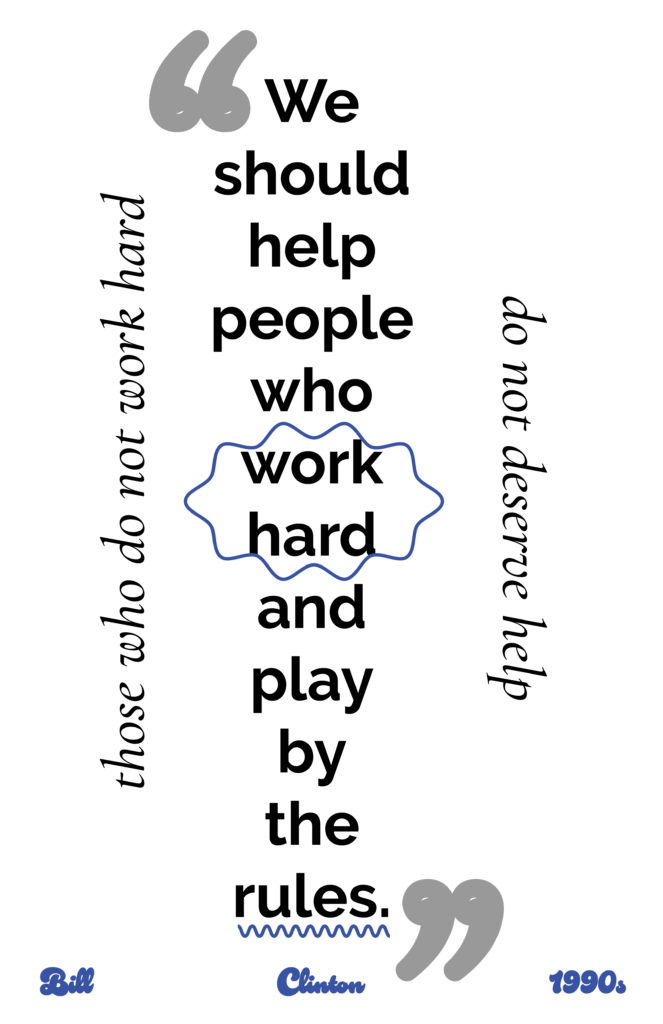
Poster 5 Prompts
Johnnie Tillmon “Welfare Is A Women’s Issue”
- What does it mean to “work hard”? Why is there such a focus on individual merit?
- What are the rules that Clinton is referring to?
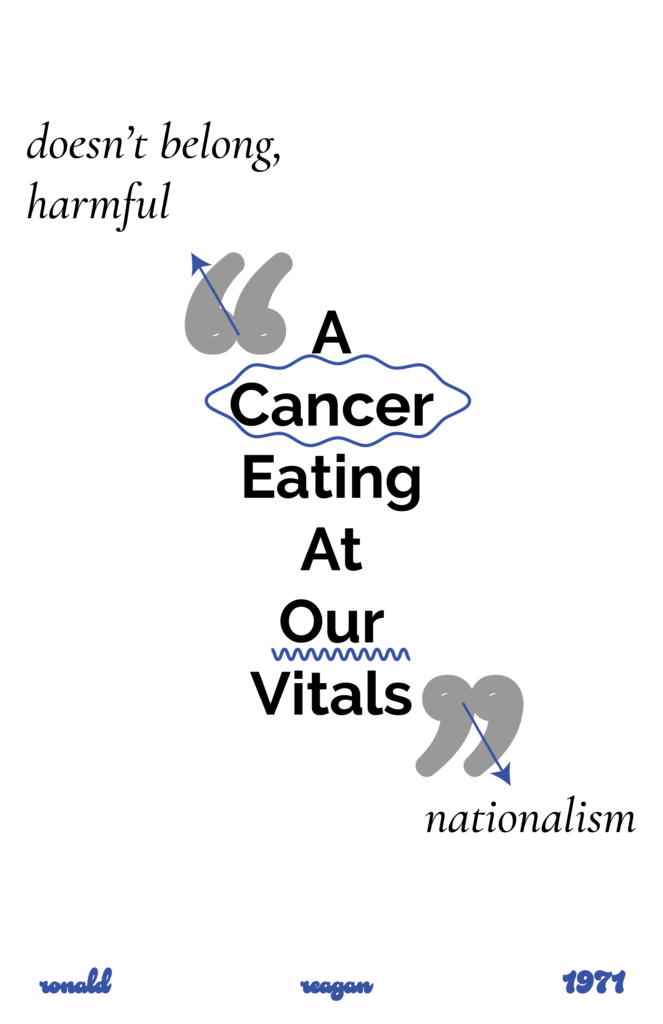
Poster 6 Prompts
Johnnie Tillmon “Welfare Is A Women’s Issue”
- What does the metaphor of a “cancer” convey?
- Who is Reagan referring to as “our vitals”?
Poster 7 Prompts
Johnnie Tillmon “Welfare Is A Women’s Issue”
- In your own words, describe this image. How do the shapes and text convey meaning?
- If you were to add to this image, what would you add?
Poster 8 Prompts
Johnnie Tillmon “Welfare Is A Women’s Issue”
- Describe Image 1. What do you see? What do you think the intended impact is of this image?
- Describe Image 2. Who is surrounding Bill Clinton? What are they doing? What are the optics at play here?
Poster 9 Prompts
Johnnie Tillmon “Welfare Is A Women’s Issue”
- Who is receiving welfare in 1929?
- Who needs to demand welfare rights in 1968?
- What else would you add to the timeline?
Poster 10 Prompts
Johnnie Tillmon “Welfare Is A Women’s Issue”
- Who is receiving welfare in 1929?
- Who needs to demand welfare rights in 1968?
- What else would you add to the timeline?
Readings
Tillmon, Johnnie. “Welfare is a Woman’s Issue.” Ms. Magazine, Spring 1972. Republished March 25, 2021. msmagazine.com.
Webb, Melody. “Welfare is Still a Woman’s Issue.” Ms. Magazine, March 2, 2023. msmagazine.com.
Further Readings
Black, Rachel, and Aleta Sprague. “The ‘Welfare Queen’ Is a Lie.” The Atlantic, September 28, 2016.
Demby, Gene. “The Mothers Who Fought to Radically Reimagine Welfare.” Code Switch. NPR, June 9, 2019.
Germain, Jacqui. “The National Welfare Rights Organization Wanted Economic Justice for Black Americans.” Teen Vogue, December 24, 2021.
Goldman, Abigail. “Welfare Rights Pioneer Tillmon-Blackston Dies.” Los Angeles Times, November 25, 1995.
Social Welfare History Project. “National Welfare Rights Organization.” VCU Libraries. Last modified August 29, 2022.
Thomas, Robert McG., Jr. “Johnnie Tillmon Blackston, Welfare Reformer, Dies at 69.” The New York Times, November 27, 1995, Section B, Page 10.
Podcasts
Abdelfatah, Rund, and Ramtin Arablouei. “How One Woman Set out to Do Something about the Financial Burden of Motherhood.” Morning Edition. NPR, June 27, 2023. Audio, 6:55
NPR’s history podcast Throughline tells the story of Johnnie Tillmon, a Black mother on welfare, who fought for motherhood to be recognized as labor worthy of pay.
Nadasen, Premilla. “Women and Black Freedom: Rethinking the Civil Rights Movement.” Rethinking the Civil Rights Movement (podcast). American Social History Project / Center for Media and Learning, April 22, 2010.
“Historian Premilla Nadasen examines the importance of women in the Black Freedom Movements of the 1960s and 1970s. In Part 1 of this podcast, she outlines how the traditional narrative of the Civil Rights Movement, which tended toward “great men approach” is being expanded in three ways: 1) the timeframe is extended beyond 1955-1968; 2) the geography is expanded to encompass the North; and 3) a broader range of activists are considered including those who promoted armed self-defense and women who focused on gender issues. In Part 2, starting at 25:40, Premilla Nadasen focuses on Johnnie Tillmon and welfare rights activism to illustrate how inclusion of this movement expands the Civil Rights narrative to include gender, economics, and women’s self-determination.”
Oral History
Tillmon, Johnnie. “Tillmon, Johnnie.” California State University Digital Archives.
“ORIGINAL INTERVIEW DESCRIPTION – This first of five interviews with Johnnie Tillmon was conducted seven years prior to the initiation of a life history interview with her. It was recorded at her “office,” a desk in the Field Office of one of the Los Angeles City Councilmen, and was done conjunction with an LA women’s movement history project by members of the Women Rising Collective. Information from these interviews were incorporated into an art installation at UCLA created by Women Rising Collective member, artist, Dara Robinson. This initial interview contains little biographical information and focuses on the organization and formation of ANC Mothers Anonymous and the National Welfare Rights Organization. Some of this material is covered in more detail in the oral history of Tillmon conducted in 1991.”