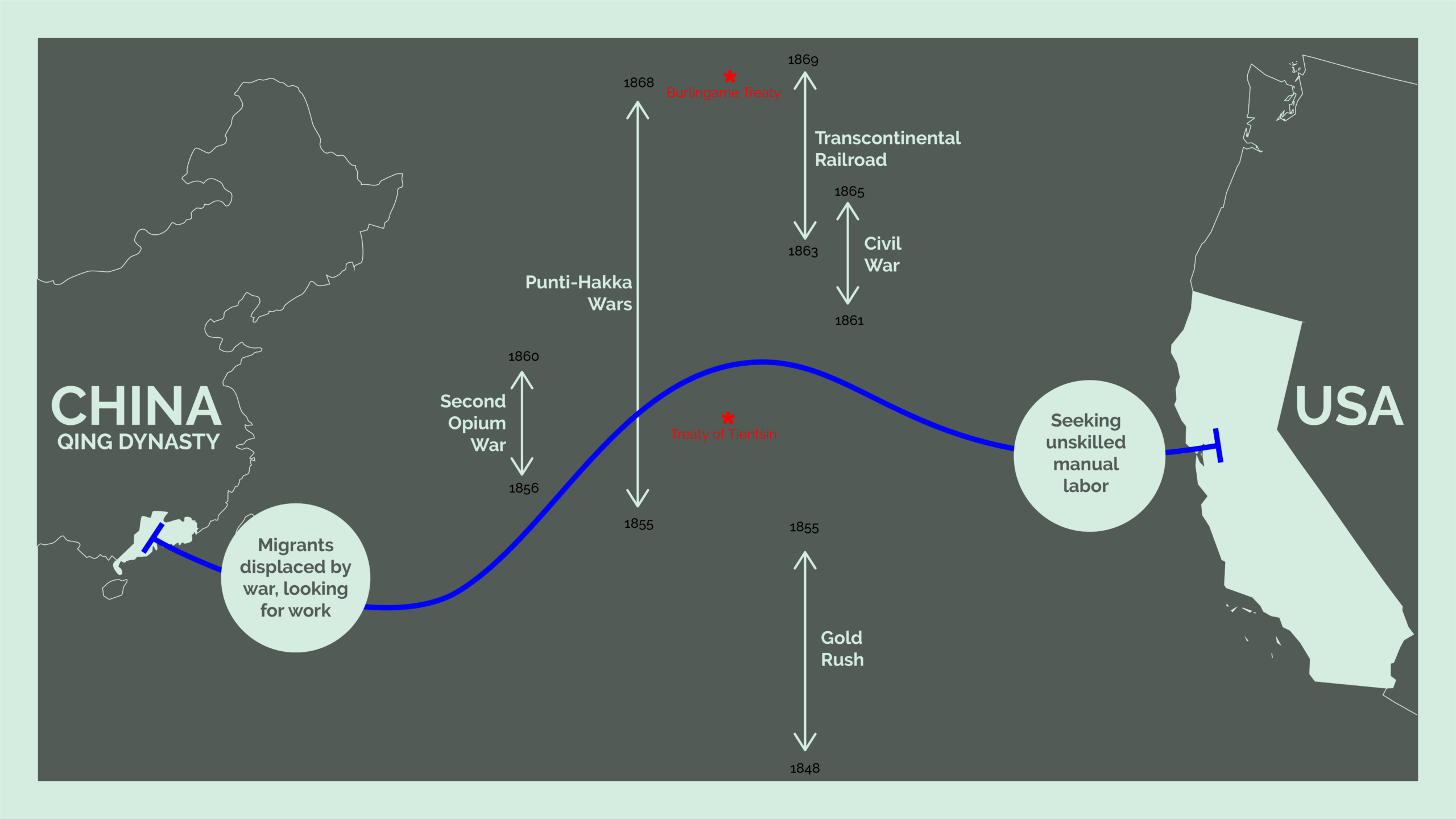
This module covers the history of Chinese exclusion in the United States. In chapter one, students learn a brief history of migrant labor from China (focusing on the railroad), and the concept of racial capitalism. In chapter two, students study two key Acts of Chinese Exclusion through the lens of the Reconstruction Era. Finally, in chapter three, students critically engage with three court cases that set precedents for how immigration, deportation, and detention function within the federal government.
Learning Objectives within Module
- Learn a brief overview of the history of migrant labor from China and the concept of Racial Capitalism.
- Study two key Acts of Chinese Exclusion through the lens of the Reconstruction Era.
- Critically engage with three court cases that set precedents for how immigration, deportation, and detention function within the federal government.
Reflection Questions within Module
- Why does historical context matter in considering why Chinese migrants (or any migrant) is on the move?
- How does capitalism, technology, and state policy produce systemic racism and inequality?
- Why are noncitizens the object of xenophobia during times of upheaval?
- How do intersections of race, gender, class (and more), shape immigrant inclusion?
- How do systems of power produce different experiences?
- How are metaphors like “invasion” used in anti-immigration rhetoric?
- What does it mean if legislation does not work as intended?
- How can you see the effects of the Chae Chan Ping decision today (plenary power over immigration)? How does this change your understanding of immigration today?
- How can you see the effects of the Fong Yue Ting decision today (deportation is not punishment)? How does this change your understanding of immigration today?
- How can you see the effects of the Wong Wing decision today (detention is not imprisonment)? How does this change your understanding of immigration today?
Accompanying Assignments
READING AN IMAGE
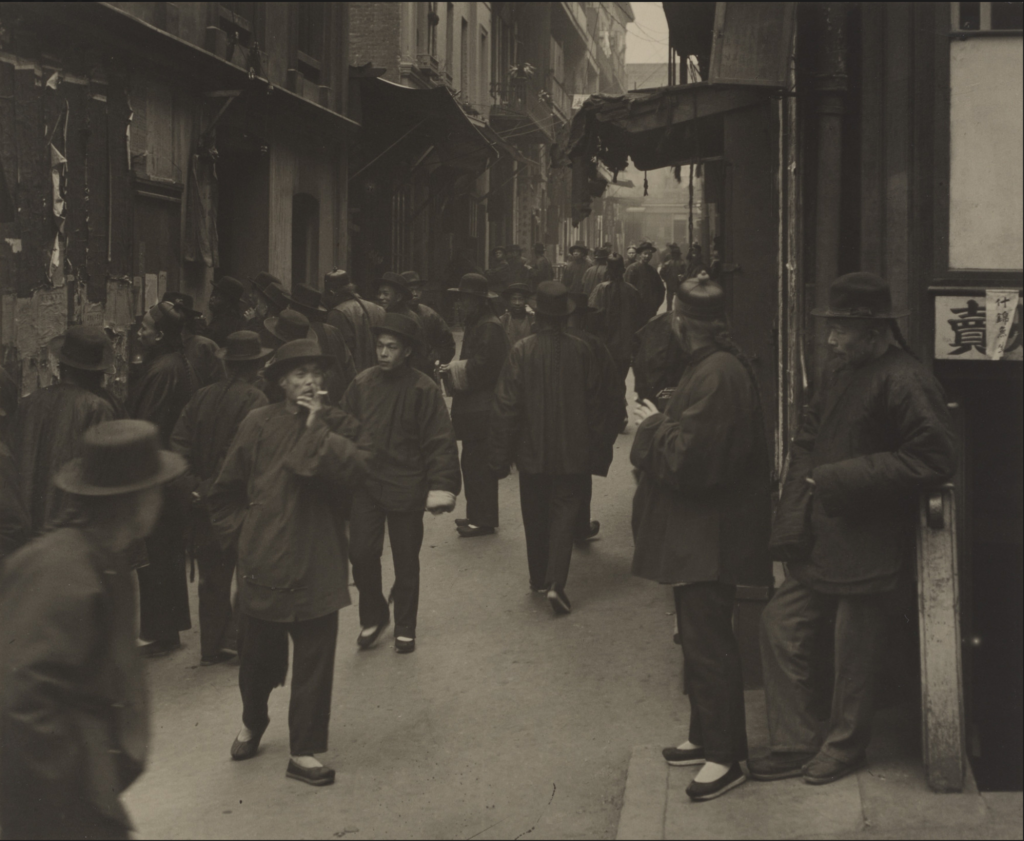
Learning how to read an image begins with observations.
Student Prompts (First Look)
Examine the photo for 30 seconds, write down what you see.
Look closer: go into detail for each quadrant of the image.
What can be deduced or inferred based on your observations?
For example:
- What is going on in the image?
- Are there people/buildings? Is the image close or far away from the subject(s)?
- Can you identify where this photo was taken or who is in the photograph?
- Is it a rural or urban scene? Is there any plant or animal species?
- Can you identify when this photo was taken? The year or even time or day or season?
Student Prompts (Second Look)
Introduce the caption of the photograph and this description from the MOMA:
Arnold Genthe
The street of the gamblers
Chinatown, San Francisco
1896 – 1906
“The images Genthe took of San Francisco’s Chinatown are the only known photographs of the historic neighborhood from before the devastating 1906 earthquake. Although an invaluable record, Genthe’s documentation reflects an outsider’s view of the segregated community, during a period when people of Chinese descent were the target of rampant, often violent discrimination and were legally barred from obtaining US citizenship. Genthe covertly photographed many of his subjects using a small portable camera. He sometimes cropped his images to remove evidence of Western culture, such as signs in English, emphasizing stereotypical attributes imposed on the neighborhood and its inhabitants. (2024)”
- How does this context from the MOMA shift your understanding of this image?
- Do you agree with the tactic of cropping (i.e. removing “evidence of Western culture”)? Why or why not?
- What happens when we “un-crop” the image?
Analyzing Metaphor
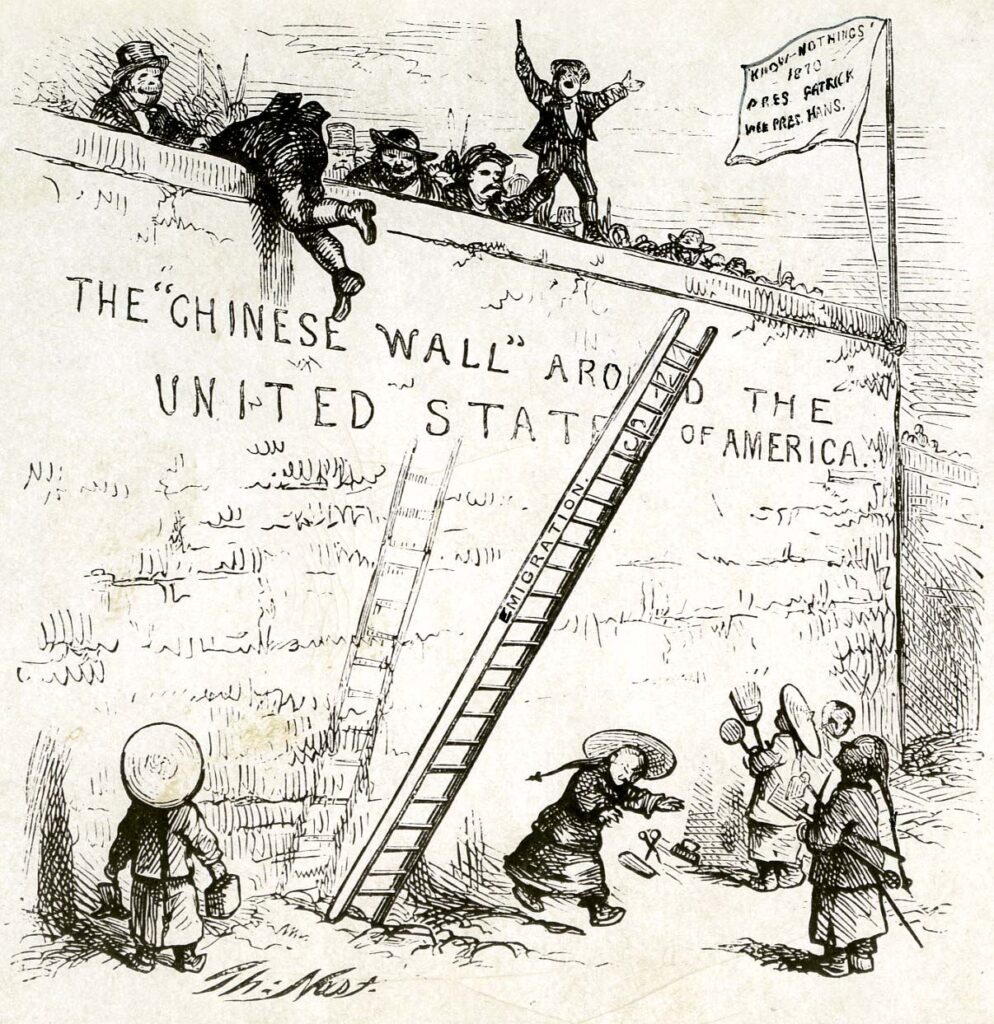
Chinese immigration“Throwing Down the Ladder by Which They Rose,” cartoon by Thomas Nast, Harper’s Weekly, July 23, 1870.
In this nativist cartoon, a metaphorical wall has been built and the ladder thrown down so no one can enter. How has the power of the imagined “wall” continued in contemporary life?
Reading on the “Know-Nothing party”:
August Samie, “Nativism,” Encyclopedia Britannica, July 19, 2023, https://www.britannica.com/topic/nativism-politics.
Student Prompts
- Why is it important to understand the history of Asian Exclusion?
- Why should we care about these laws passed nearly 150 years ago?
- How does Asian Exclusion set precedents for what we are seeing today?
- How does race, gender, and class interact with nationalism and nativism to target certain migrants (and not others)?
Power & Documents
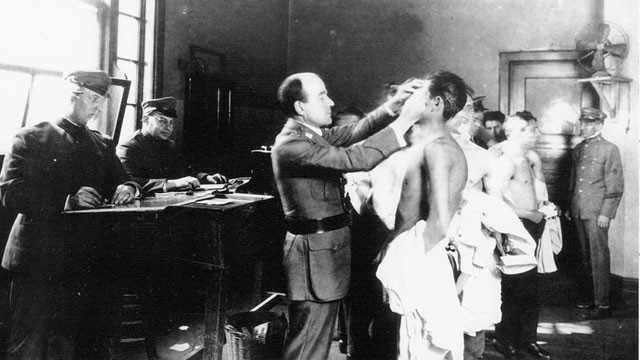
National Archives and Records
Health inspectors examine detainees
Angel Island, California
C. 1917
In this photograph from an Angel Island inspection, bodies are examined and translated to paper.
Student Prompts
Have students think about the role of power in this room. Answer each question in two ways: from the perspective of the observed and the perspective of the observer.
- Who are the people on the right side of the photograph?
- Who are the people on the left side of the photograph?
- What is the action? What is happening?
- What is the reason? Why is this happening?
Further Reflection
How does this production of the “illegal alien” in the U.S. relate to the rise of criminalization, particularly in the late 20th century?